

Sacrificial Anodes for Ships and Boats: Types, Uses and How to Choose
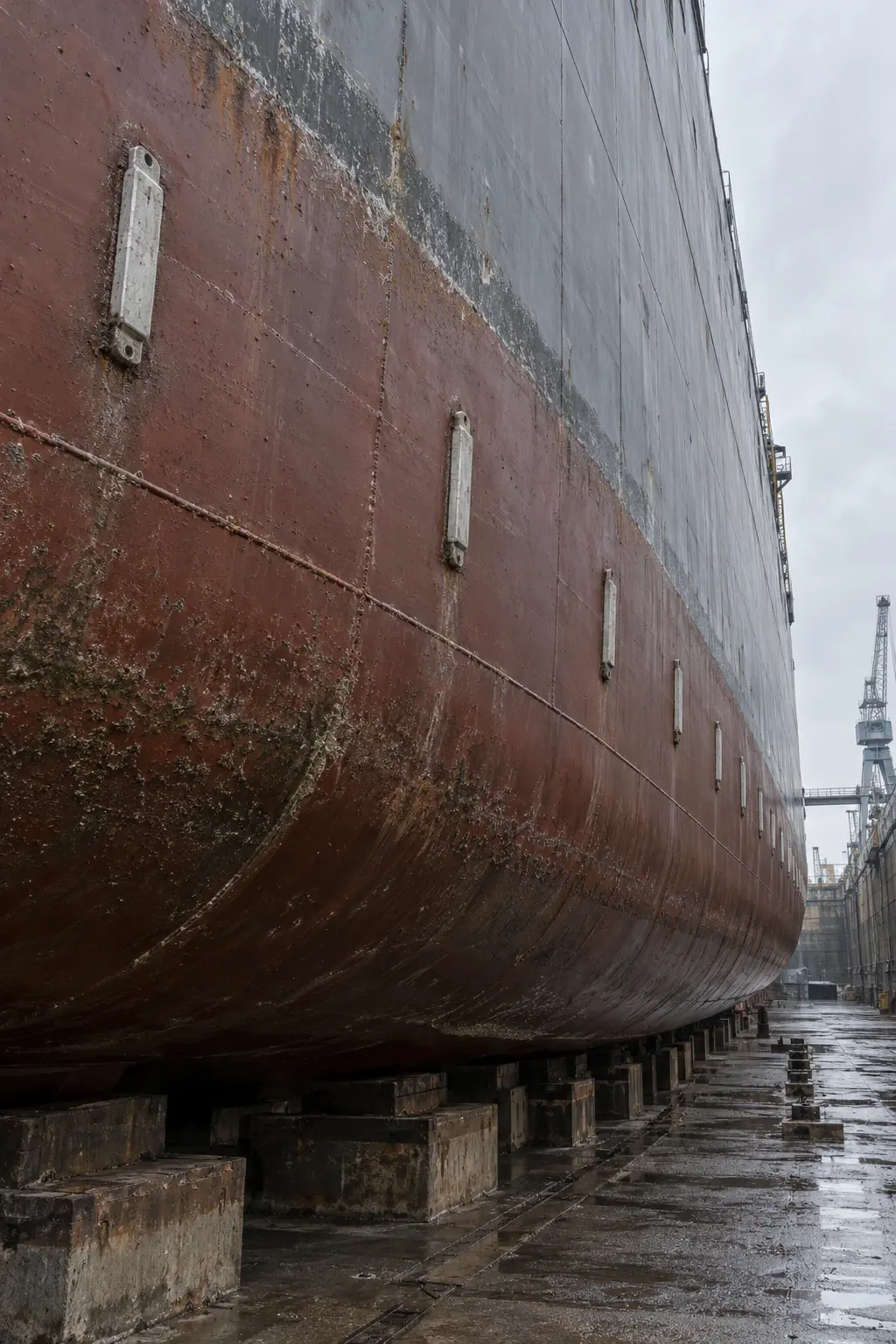
A sacrificial anode is a block of zinc, aluminium or magnesium alloy fixed to a steel structure in water, such as a ship’s hull, ballast tank, propeller shaft or jetty pile. Its potential is more negative than steel’s, so it corrodes in the steel’s place. This is galvanic cathodic protection, and the part is also called a galvanic anode.
Last updated:
What is a sacrificial anode?
A sacrificial anode is a casting of an electrochemically active alloy, normally based on zinc, aluminium or magnesium, that is electrically connected to the structure it protects. It is the source of the protective current and is consumed as it works, which is why it is called sacrificial. Galvanic anode means the same thing, and the alloy gives the everyday names: zinc, aluminium and magnesium anodes.
Boat anodes are often simply called “zincs”, whatever they are made of; in Turkish yards the same part is called tutya, a word that originally meant zinc. They should not be confused with the inert anodes of an impressed current (ICCP) system, which are not consumed and are fed from a power supply.
How do sacrificial anodes work? Galvanic anodes vs ICCP
When two different metals are electrically connected in an electrolyte such as sea water, the one with the more negative potential corrodes and the other is protected. Zinc, aluminium and magnesium alloys are all more negative than steel, so once a sacrificial anode is bonded to a hull, corrosion takes place on it rather than on the steel. The steel becomes the cathode of this cell: it is cathodically protected.
For carbon steel in aerated sea water, the protection criterion is a potential of −0.80 V or more negative against an Ag/AgCl/seawater reference electrode. The pure metals perform poorly: pure aluminium passivates under its oxide film and pure magnesium self-corrodes rapidly, so sacrificial anodes are always cast from alloys. They are used up as they work; ICCP systems give the same protection with inert, non-consuming electrodes and a rectifier.
| Aspect | Sacrificial (galvanic) anodes | ICCP (impressed current) |
|---|---|---|
| Power and operation | No power supply needed; no risk of reversed polarity | Needs a DC power supply and trained staff; polarity can be reversed if wrongly connected |
| Current | Not adjustable | Adjustable and can be monitored |
| Replacement | When about 50 % consumed; losing a few has little effect | Not needed; they are inert and not consumed |
| Ballast tanks | Used; ABS calls for galvanic protection only in ballast tanks | Not used, because it may generate hazardous hydrogen |
Zinc vs aluminium vs magnesium anodes
Sacrificial anodes are cast from three alloy families: zinc (Zn-Al-Cd), aluminium (Al-Zn-In) and magnesium (Mg-Al-Zn or Mg-Mn). The choice depends on the salinity of the water, its temperature and how much weight you can carry.
| Property | Zinc | Aluminium | Magnesium |
|---|---|---|---|
| Suitable water | Sea water and seabed mud; not recommended in fresh water, may passivate in brackish water | Sea water, brackish water and seabed mud; not normally effective in fresh water | Fresh water only; not used in sea water or brackish water |
| Potential (V) | Design −1.00; typical −1.03 | Design −1.05; typical −1.09 | Standard ≈ −1.5; high-potential ≈ −1.7 |
| Driving voltage (V) | ≈ 0.20–0.23 | ≈ 0.25–0.29 | ≈ 0.70–0.90 |
| Capacity (Ah/kg) | 780 (design and typical) | 2,000 (design); 2,500 (typical) | ≈ 1,200 (typical); current efficiency ≈ 50 % |
| Consumption (kg/A·year) | 11.2 | 3.5 (typical) | 7.3 |
| Density (kg/dm³) | 7.13 (heaviest) | ≈ 2.75–2.78 | ≈ 1.7–1.8 (lightest) |
| Typical use | Ship hulls, sea chests, ballast tanks, propeller and shaft collars, sea water side of condensers | Ship hulls, ballast tanks, offshore platforms, jetty and harbour piles, craft in salt and brackish water | River and lake craft, fresh water side of heat exchangers |
| Watch out for | Standard alloy up to 50 °C; in some hot fresh waters its potential can reverse | In tanker cargo tanks and adjacent ballast tanks, falling energy of 275 J at most; capacity falls as temperature rises | Over-protection and very fast consumption in sea water; not accepted in ballast or cargo tanks |
Zinc anodes give a steady, predictable protective current in sea water. The 275 J falling-energy limit that applies to aluminium in tankers does not apply to zinc, and DNV notes that zinc can be more reliable than aluminium in seabed mud and in closed compartments with high bacterial activity.
Aluminium anodes deliver the most charge per kilogram: at design values, the same ampere-hours take about 40 % of the mass of zinc. Aluminium is normally preferred offshore and also works in brackish water. Size for size it weighs about 39 % as much as zinc, so by our calculation at design values the two deliver almost the same charge per unit volume: the real gain is weight.
Magnesium anodes have the highest driving voltage. Because sea water conducts so well, ABS notes that this leads to over-protection and very fast consumption in salt water, which is why magnesium is for fresh water only.
You can tell zinc from aluminium by weight and by marking: DNV requires each anode to carry the manufacturer’s name or symbol, a material letter (“A” for aluminium, “Z” for zinc) and its heat and serial numbers.
Which anodes for saltwater, brackish water and freshwater?
- Salt water (sea): aluminium or zinc. Volvo Penta recommends aluminium, with zinc if aluminium is not available.
- Brackish water and estuaries: aluminium. Zinc can passivate in brackish water.
- Fresh water (rivers, lakes): magnesium. In fresh water, zinc and aluminium become covered with an off-white oxide crust that seals the metal and stops it working.
- Hot circuits: standard zinc is used up to 50 °C; aluminium’s capacity drops from 2,500 Ah/kg at 25 °C to 500 Ah/kg at 80 °C.
For boat anodes that must work both at sea and in estuaries, aluminium is the most flexible choice. ABS notes that magnesium is not used on the aluminium hulls of seagoing ships; on small aluminium boats kept in fresh water, it may be used as the boat or engine maker recommends.
Where are sacrificial anodes fitted on ships and boats?
ISO 20313 covers cathodic protection of ships’ hulls and ballast tanks, including rudders, propellers, shafts, thrusters, sea chests and water intakes. The main locations, with the rules from the ABS guidance:
- Hull: spread the sacrificial anodes evenly over the underwater hull; many small ones protect more efficiently than a few large ones. At the bilge amidships, keep them no more than 6–8 m apart, closing to about 5 m in low-resistivity water and the tropics. Where a bilge keel is fitted, they are preferably attached alternately to its upper and lower sides. None go in way of the anchor, and all are fitted flat to the hull to reduce drag.
- Propeller, shaft and rudder: nothing is fitted in the zone 0.4D–1.1D ahead of the propeller (D is the propeller diameter), and the rudder is protected on both sides. A turning shaft is insulated from the hull by the oil film in its bearings, so the propeller is bonded to the hull with a shaft earthing device or protected by a zinc collar on the shaft.
- Sea chests: an anode outside an opening protects only to a depth of 1–2 times the opening’s diameter, so more are fitted inside the box.
- Bow and stern thrusters: as close as possible to the areas at risk, welded rather than bolted in the tunnel.
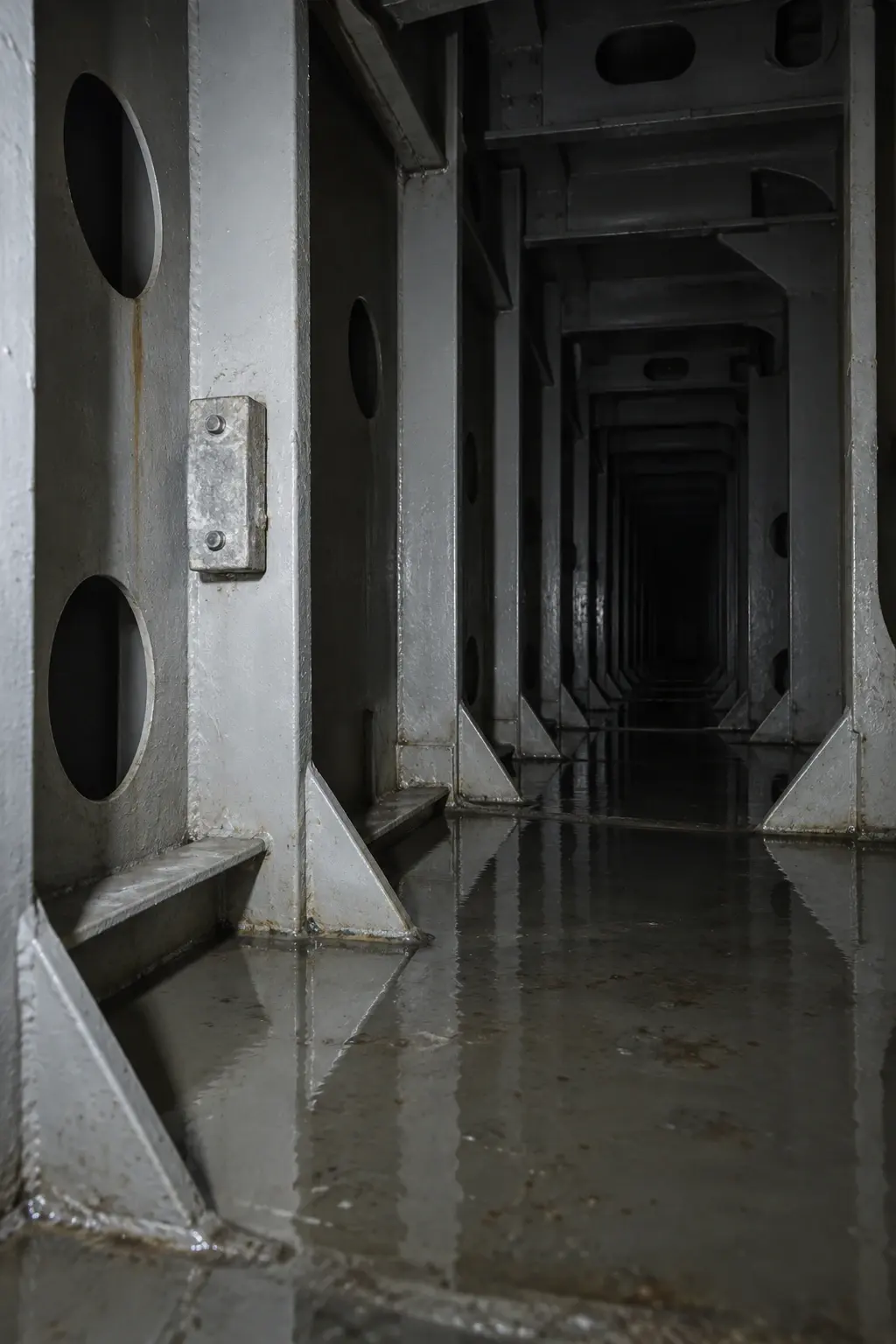
- Ballast tanks: several small anodes rather than one large one, mainly in the lower part of the tank; they only work where they are submerged at least half the time. Magnesium is not accepted in ballast tanks, and on tankers aluminium in tanks next to cargo is limited to a falling energy of 275 J.
- Condensers and heat exchangers: zinc or aluminium on the sea water side, magnesium on the fresh water side.
- Ports and offshore: jetty piles, dolphins, sheet piling and pontoons (ISO 13174) and fixed platforms. DNV notes that simple galvanic anodes, which need no power, are usually preferred offshore.
If a ship will rely on sacrificial anodes in service, they are fitted before launching. On yachts and small craft, boat anodes typically sit on the shaft, the rudder and the transom.
How are anodes installed? Weld-on and bolt-on types
A sacrificial anode is cast around an insert of a less active metal such as steel, which keeps it strong and electrically connected until the end of its life. The weld is made on this insert, never on the zinc, aluminium or magnesium itself.
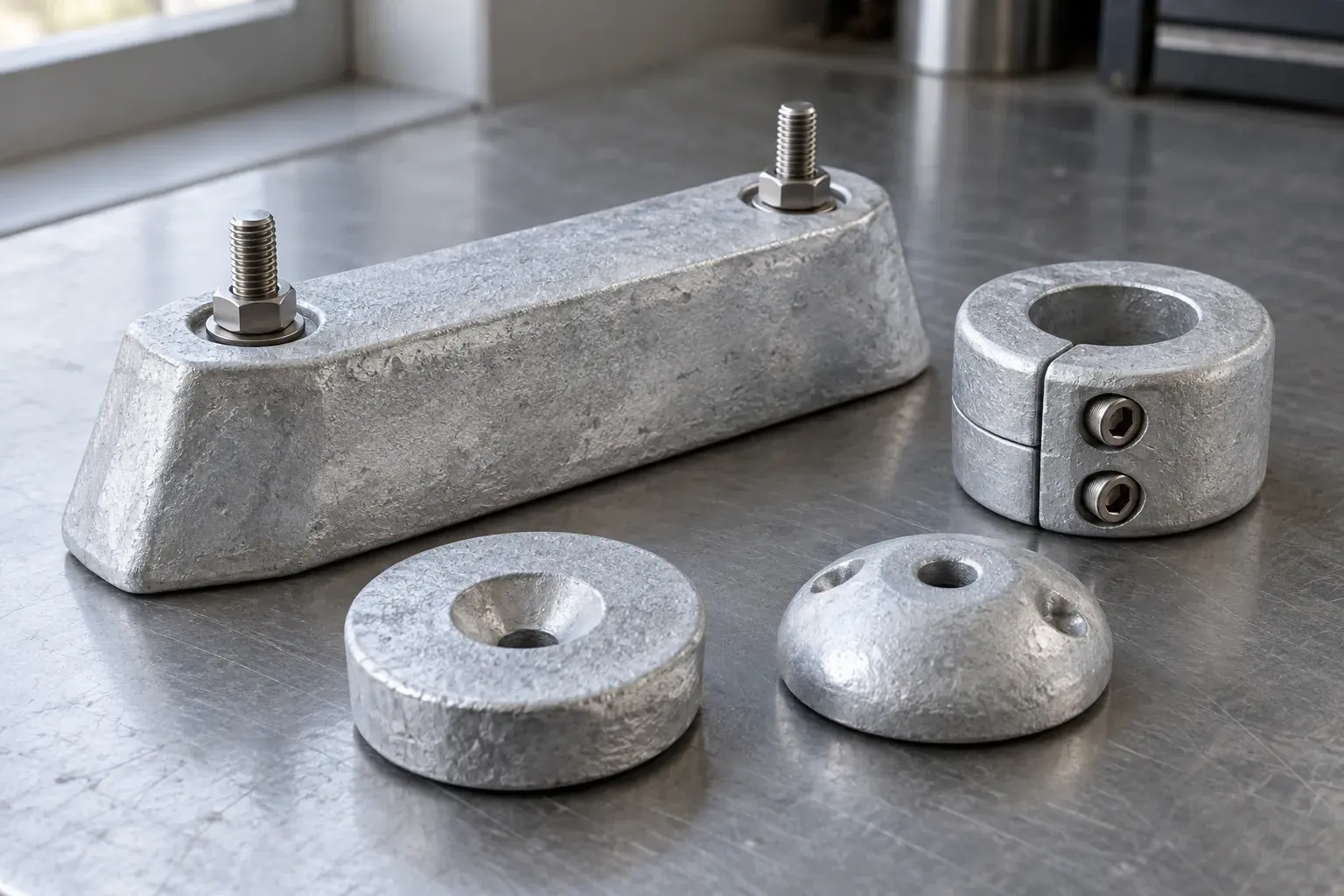
- Weld-on anodes: the insert is welded to the hull or tank structure, and no extra continuity cable is needed. On thin plating, a doubler plate with a 20 mm border is used.
- Bolt-on anodes: DNV-RP-B401 requires a continuity cable of at least 16 mm² wherever the fixing is not welded, and the resistance to the structure must not exceed 0.1 Ω.
- Cable connection: ABS calls for more than one multi-stranded cable of at least 10 mm². Studs fired into the structure are not permitted.
- Shaft collar, disc and dome anodes: used on boats, on the shaft, rudder and transom. A shaft collar must not unbalance the shaft or restrict the water flow to its bearings.
- For non-standard locations, the casting can be made in a mould to drawing and dimensions: custom anodes and castings.
Whatever the method, a low-resistance electrical contact with the structure must be kept for the whole working life. The standards describe welding, bolting and cable connections; bonding with adhesive is not among them.
Never paint a sacrificial anode: paint stops it working. Protect it during coating work and remove any paint spilled on it; only the back face of a flush-mounted anode, facing the structure, may be coated.
When to replace sacrificial anodes and how long do they last?
The ABS guidance says to replace sacrificial anodes when about 50 % or more has been consumed, and Volvo Penta advises replacing them when they have eroded to half their original size. On ships, the decision is made at dry-docking: if what remains will not last until the next docking, they are renewed.
The life of a sacrificial anode cannot be given as a number of years. It depends on its mass, the alloy’s capacity and the current the structure draws. In design, only the utilisation factor’s share of the mass is counted (0.80–0.90 under DNV, depending on shape); beyond that, the current output becomes unpredictable. Replace with the same alloy, because the system is designed around that material.
- Not wasting at all: the alloy may have passivated because it does not suit the water, its electrical contact may be broken, it may have been painted, or the alloy may contain impurities such as iron and copper. The next most active metal in the bonding system then starts to sacrifice itself instead.
- Wasting unevenly: among anodes of equal resistance, the lightest is consumed first; among those of equal mass, the one with the lowest resistance goes first. DNV requires the current output to mass ratio not to differ by more than 50 % across one structure.
- Wasting too fast: magnesium is consumed very quickly in salt water, and aluminium’s consumption rises from 3.5 kg/A·year at 25 °C to 17.5 kg/A·year at 80 °C.
Sacrificial anode calculation: how much do you need?
First work out the protective current the structure needs, then the net mass of sacrificial anodes that will deliver that current over the design life. DNV-RP-B401 and ABS use the same formula; for a ship, the design life is the interval between dry-dockings.
- Current demand: I = A × i × f, where A is the protected surface area (m²), i the design current density for bare steel (A/m²) and f the coating breakdown factor, whose mean value is f = a + b × t/2.
- Net mass: M = I × t × 8760 / (u × ε), where t is the design life (years), 8760 the hours in a year, u the utilisation factor and ε the alloy’s capacity (Ah/kg).
Illustrative example (not a design): water at 12–20 °C, depth 0–30 m, 1,000 m² of coated steel, a mean current density of 0.080 A/m², a category II coating and 5 years. f = 0.05 + 0.025 × 5/2 = 0.1125; I = 1,000 × 0.080 × 0.1125 = 9.0 A. With long flush-mounted anodes (u = 0.85), the net mass is 9.0 × 5 × 8760 / (0.85 × 2,000) ≈ 232 kg for aluminium and ≈ 595 kg for zinc. This DNV method is for fixed offshore structures; ship hulls are designed to ABS or ISO 20313.
| Dry-docking interval | Mean current density |
|---|---|
| Up to 18 months | 15–25 mA/m² |
| 19–36 months | 26–45 mA/m² |
| 37–60 months | 46–75 mA/m² |
Let us do the calculation for your project: send the vessel type, wetted surface or tank area, coating, dry-docking interval and water through the contact form, and we will work out the cathodic protection calculation, anode layout and life projection with you.
What drives the price of sacrificial anodes?
There is no single price. The main factors are:
- Alloy: zinc, aluminium and magnesium differ in metal price and alloy content, and prices move with the metal markets.
- Weight and size: size for size, aluminium weighs about 39 % as much as zinc, so compare the cost per ampere-hour delivered, not just the price per kilogram.
- Type and fixing: weld-on, bolt-on, shaft collar or disc types; steel inserts and any custom mould.
- Quantity: order quantity and batch size.
- Documents: the class type approval required, the batch analysis report and the scope of testing. DNV-RP-B401 calls for an electrochemical quality test on orders over 15,000 kg.
- New versus scrap: the price of scrap zinc is no guide to the price of new castings.
For a current price, send your list of sizes and quantities with the ship or boat details, and we will prepare a quotation for you.
Sacrificial anode manufacturer in Tuzla, Istanbul
In operation since 2006, Detay Group makes sacrificial anodes and other cast materials in Tuzla, Istanbul. Our zinc and aluminium anodes are cast in our own foundry, each batch with its chemical analysis report; magnesium is supplied, not cast in-house.
- Zinc anodes (cast in-house): LR and CCS type approved; weld-on or bolt-on, for hulls, sea chests, ballast tanks and bow and stern thrusters.
- Aluminium anodes (cast in-house): LR type approved alloy; for ballast tanks, hulls, offshore platforms and jetty and harbour piles.
- Magnesium anodes (supplied): hull, shaft collar, disc and dome models for craft and circuits in fresh water.
- Custom sizes: moulds made to drawing and dimensions, from one-off parts to series.
- Polcor and MARPO brands supplied, plus cathodic protection calculation, anode layout and life projection.
For sacrificial anodes, type approval certifies that a representative sample meets the design criteria; it does not replace normal inspection and survey, which is why the batch analysis report matters. For ICCP, MGPS and shaft earthing, see our products.
Send us the details of your boat, ship or structure and we will work out the right anode alloy and quantity with you.
REQUEST A QUOTEOur anodes
ALL PRODUCTS →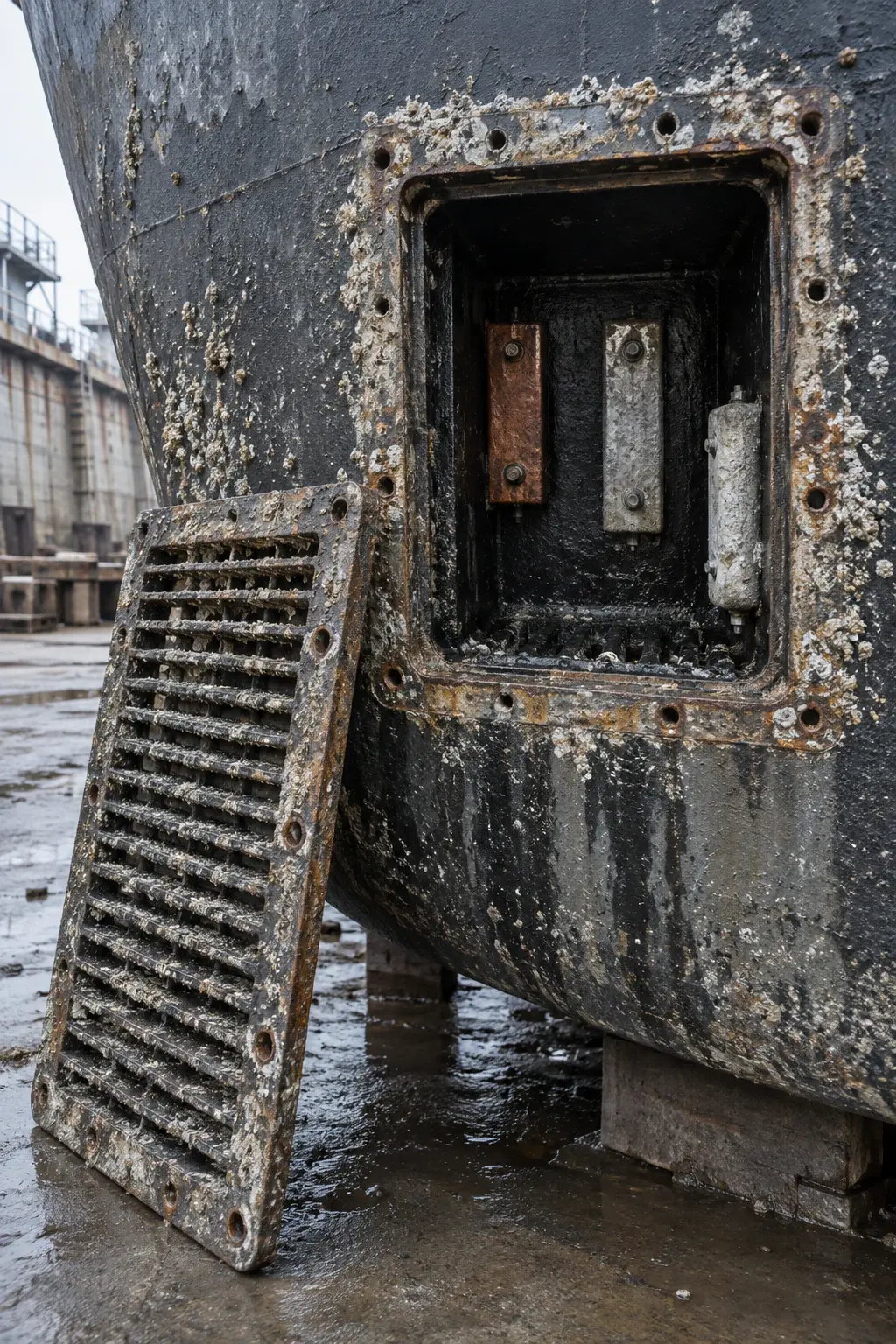
Frequently asked questions
What is the purpose of sacrificial anodes on ships and boats?
It protects the steel it is bonded to from corrosion. Its potential is more negative than steel’s, so in water it corrodes instead of the steel; the steel becomes the cathode and its corrosion largely stops. On a ship, sacrificial anodes go on the hull, in sea chests and ballast tanks and on the rudder and shaft; ashore, on jetty piles, and offshore, on platforms. Because they are used up as they work, they are checked and renewed regularly.
Zinc or aluminium anodes: which is better?
It depends on the water and the application. Aluminium gives far more capacity per kilogram (a design value of 2,000 Ah/kg against 780 Ah/kg for zinc), is lighter and also works in brackish water; it is normally preferred offshore. Zinc is stable in sea water, is not subject to the 275 J falling-energy limit in tankers and can be more reliable in compartments with high bacterial activity. When replacing, keep to the alloy already fitted.
Do zinc and aluminium anodes work in fresh water?
Not normally. In fresh water, zinc and aluminium become coated with an off-white oxide crust, passivate and stop protecting, so the choice is magnesium anodes. Magnesium, on the other hand, is not used in salt or brackish water: it over-protects in sea water and is consumed very quickly. For boats that work both at sea and in estuaries, that is in salt and brackish water, aluminium is the right choice.
Can you paint sacrificial anodes?
No. Paint stops a sacrificial anode working. The MIL specifications require “DO NOT PAINT” to be cast or stamped on its exposed face, and DNV requires anodes to be protected during coating work and any spilled paint to be removed. When a ship or boat is painted or antifouled, protect them. Only the back face of a flush-mounted anode, facing the structure, may be coated.
Can sacrificial anodes be welded?
Not the metal itself. Sacrificial anodes are cast around a steel insert, and this insert is welded, bolted or cable-connected to the structure. A welded fixing needs no extra cable; for any other fixing, DNV requires a continuity cable of at least 16 mm², and the resistance must not exceed 0.1 Ω. The low-resistance contact must be kept for the whole working life.
How often should sacrificial anodes be replaced, and how long do they last?
There is no fixed interval or life in years: it depends on the anode’s mass, the alloy’s capacity and the current the structure draws. ABS says to replace a sacrificial anode when about half or more of it has been consumed. On ships they are checked at dry-docking and renewed if what remains will not last until the next docking; for boats, the advice is to replace them when they are down to half their original size. Choose the same alloy as the existing system. One that is not wearing at all is also a warning sign.
Is it good if a sacrificial anode is not wearing away?
No. If it is not wasting, the protection may not be working. Possible causes are passivation because the alloy does not suit the water (zinc in fresh water, for example), poor electrical contact, paint on the surface and impurities such as iron and copper in the alloy. Once it passivates, the next most active metal in the bonding system starts to sacrifice itself, so check the contact and the alloy.
Can you mix zinc and aluminium anodes, or switch from one to the other?
Treat it as a change to the cathodic protection design, not a like-for-like swap. The system is designed around the anode material, so replacements are normally of the same type, and DNV expects the units on one structure to have a similar current output to mass ratio. Aluminium needs far less mass for the same charge, so their number, size and position should be rechecked. On tankers, also check the 275 J falling-energy limit.
How do you calculate sacrificial anodes for a ship?
First work out the current the structure needs, I = A × i × f (area, design current density and coating breakdown factor), then the net mass, M = I × t × 8760 / (u × ε), where t is the design life, u the utilisation factor and ε the alloy’s capacity in Ah/kg. For a ship, the design life is the dry-docking interval, and ABS gives typical mean current densities of 15–25 mA/m² for up to 18 months. Send your vessel details through the contact form and we will work the calculation with you.
Sacrificial anodes or ICCP: which is better for a ship?
Neither is better everywhere. Sacrificial anodes need no power supply and cannot be wired with reversed polarity, but their current is not adjustable and they are renewed when about 50 % consumed. ICCP needs a DC supply and trained staff, but its current can be adjusted and monitored and its inert electrodes are not consumed. ABS calls for galvanic protection only in ballast tanks, because ICCP may generate hazardous hydrogen there.
How much do sacrificial anodes cost?
The price depends on the alloy, weight, type, quantity and the documents required, and it moves with metal prices, so we quote to your requirement rather than from a fixed list. When comparing prices per kilogram, remember that aluminium is much lighter than zinc and gives the same protection with fewer kilograms. Send your list of sizes and quantities for a quotation.
Request a quote for your project.
Write to our technical team with vessel type, anode grade and quantities, a cathodic protection calculation or a service request. Send drawings and a measurement list and we will return a tooling and production quote shortly.
- ADDRESS
- Evliya Çelebi, 34944
Tuzla / İstanbul · TÜRKİYE - PHONE
- +90 216 447 20 24